
Last week I tucked three starters into my microwave, each fed at a different ratio, hoping for sweet, sweet yeast. What I got was a pink sourdough starter. Three of them, actually.
The pink was the second surprise. The first was the smell.
Not acetone.
Not sweet yeast, either.
Feet. By day three, that’s what all three jars smelled like.
Three Starters, Three Ratios
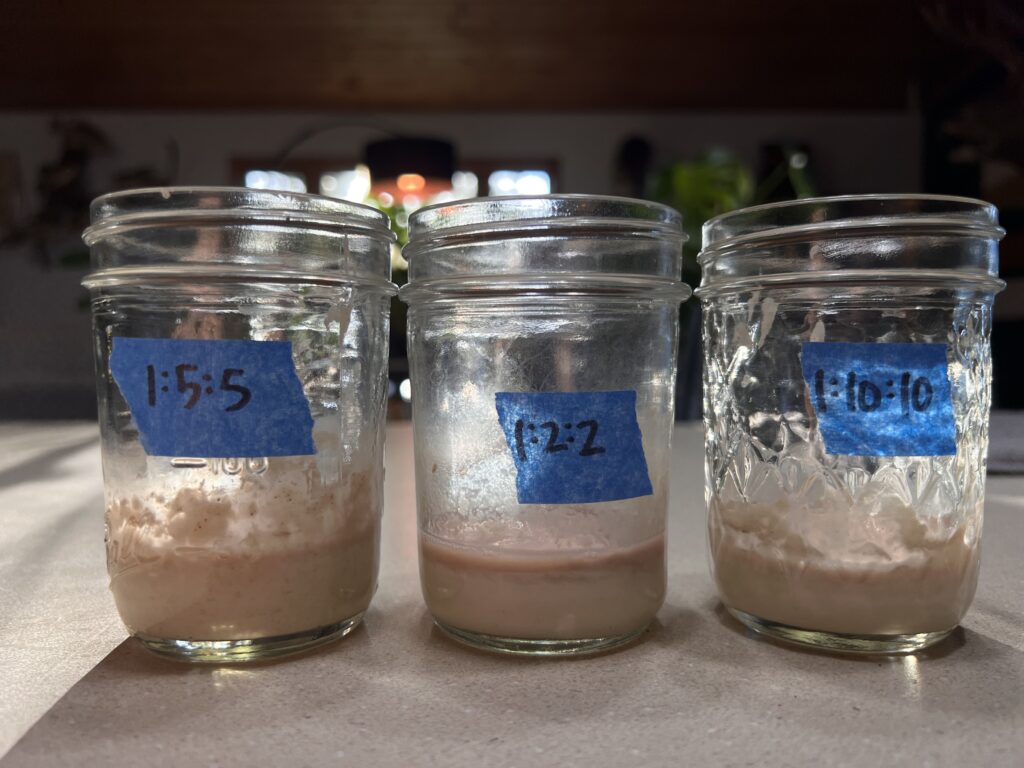
I had hope after the first day. The acidic smell faded and the starters smelled a little sweeter. I was thrilled. I figured I’d finally worked out how to feed this damn thing.
I watched each jar and waited for it to peak on its own time. Each jar got fed at its peak, and I never let one fall. I read the starter, not the clock. The 1:2:2 peaked at 12 hours, the 1:5:5 at 14 hours, and the 1:10:10 at 24.
By day two, things were still going well. I repeated the process, feeding each jar at its peak and nestling them back into the microwave with the door cracked, where it holds a steady 75°F. Every hour or so, I poked my head in to check the bubbles and see how far each jar had climbed above its hair tie. My goal was to catch the rise, then the leveling off, and feed before any of them collapsed.
I washed the jars between feedings so I could see the rise marks clearly. I didn’t change the water, the flour, or the spot. The only variable was the feeding ratio.
The Smell Test
Day three is where it all fell apart.
We had company visiting from out of state. She had been following my starter’s progress, so I was thrilled she arrived just as things were finally looking up. I told her about the experiment and couldn’t wait for her to sniff a jar.
Mind you, she has a spectacular palate. She doesn’t cook much, but she can taste a dish and name the one ingredient the cook left out.
When I asked her to smell the jar, I was excited.
Immediate gag reflex.
Not the reaction I was hoping for.
“Oh, honey. That smells like moldy feet.”
Well…shit.
I’d been so happy to see any change that I had blinders on. The smell was different, but different wasn’t the same as better. The acetone was gone, and something unpleasant and unfamiliar had taken its place.
I felt discouraged. After two months of troubleshooting, I was over it. We had a busy week planned, and I couldn’t watch the jars the way I had the first two days. I had a backup jar in the fridge, saved from before the experiment, and I’d fed it before tucking it away. So I decided to leave the three jars alone and see what happened.
I kid you not, by that evening there was a pink tinge on the surface of all three.
I left them a little longer, just to be sure.
By day five, I was sure. I had a pink sourdough starter. Make that three.
What a Pink Sourdough Starter Means
A pink or salmon tint isn’t part of normal sourdough fermentation. It’s a sign of unwanted microbial growth, and one bacterium commonly associated with pink or red pigmentation is Serratia marcescens — the same general culprit behind the pink film you sometimes see around sinks and shower grout. I can’t say that’s what happened in my jars, and I’m not going to pretend I can identify a microorganism by looking at a jar of starter.
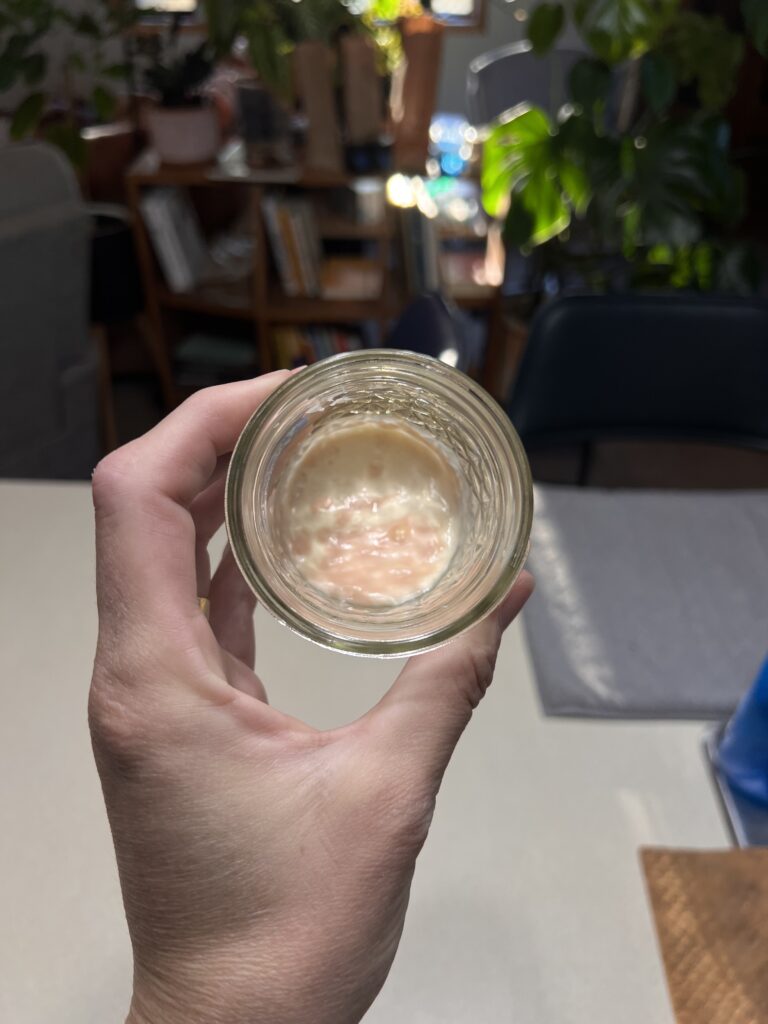
What I do know is that a pink sourdough starter has to go. King Arthur’s advice is to toss a starter with pink or orange streaks, so that’s what I did.
Then I gave the kitchen a deep clean, because I didn’t want a second pink sourdough starter. Countertops, microwave, utensils — anything that had come into contact with the three jars got cleaned.
I feel downright defeated.
What I Think Caused My Pink Sourdough Starter
Here’s my best guess. It’s a guess, and I want to be clear about that.
A feeding ratio determines how much of your old starter carries into the new batch. Here’s what that looked like in my three jars, plus the 1:1:1 I’d been using before:
- 1:1:1: about a third of the jar is old starter
- 1:2:2: one fifth
- 1:5:5: about 9 percent
- 1:10:10: under 5 percent
That old starter carries acid and an established population of sourdough microorganisms. The acid matters because a healthy starter is acidic enough to discourage many unwanted microbes from getting established.
A Bigger Meal, a Longer Wait
When I fed at a higher ratio, I diluted that acidity and gave the existing starter a much larger meal. That’s supposed to buy the starter more time before it peaks. The problem, at least in my experiment, is that the 1:5:5 and 1:10:10 starters took 14 and 24 hours to peak.
That’s a long window.
I was keeping those jars at 75°F, which is just as comfortable for unwanted microbes as it is for yeast, and I had dramatically diluted the acidity that had built up in the old starter. My best guess is that the combination gave something unwanted an opportunity to get established.
Then I stopped feeding them, and by that evening the pink had moved in.
I can’t prove any of this. The 1:2:2 jar wasn’t diluted nearly as much and it failed too. My backup in the fridge still smells acidic and never went pink. That’s not a fair comparison — it was colder, and I fed it differently — but it’s a clue.
What I’d Change After a Pink Sourdough Starter
It also changes how I read my last post.
I set a goal of doubling in six to eight hours. That benchmark makes sense for a 1:1:1 feeding under favorable conditions. At 1:5:5 and 1:10:10, a longer wait is part of the point. The bigger the meal, the longer the starter can take to work through it.
I think I got too focused on finding the ratio that would make my starter stronger and forgot how much one change can set in motion. A bigger ratio meant less old starter in the jar, and it also meant a longer wait between feedings. Then I got busy and left all three unattended.
That’s not exactly a controlled experiment.
If I try higher ratios again, I’ll step up more slowly instead of jumping straight to the biggest meals. And I won’t walk away from a jar mid-experiment.
Where I Go From Here
I’m still not quitting.
After this much time, and one very pink sourdough starter, I want to know I can build a starter myself. I could call a few girlfriends and ask for a scoop of theirs, and there’s nothing wrong with that. I just want this one.
Last post, I said that if this didn’t work, I’d start over from scratch. I meant it. But I still have the backup in the fridge, and it still smells acidic even though I fed it before tucking it away.
I haven’t decided whether to revive it, start completely over, or do both.
Apparently, the sourdough chronicles continue.