Ask someone where they caught their biggest walleye, and you’ll probably get a vague answer. Ask a forager where they pick wild blueberries, and you’ll get the same response.
While you may not get the exact location from a seasoned forager, what doesn’t change is the environment where wild blueberries grow and thrive. If you know where to look, odds are you’ll have some luck finding them. This is what we looked for when we headed out to scout.
Wild blueberries thrive in acidic soil. Look around. Pay attention to the trees. You won’t find them in an old oak grove or maple ridge. Instead, look for evergreen forests dominated by pine. As the needles break down, they naturally acidify the soil beneath them.
They also prefer well-drained sandy soil, rocky woods, or peat-heavy wetlands. Their roots stay close to the surface and need plenty of air, so the ground needs to drain well without holding onto too much water.
This was the extent of my knowledge, pieced together from conversations with friends and family who have picked blueberries for years. I’m an overthinker. I knew if I disappeared down the rabbit hole of research, I’d overwhelm myself and eventually talk myself out of going altogether.
So instead, I decided to just go scouting.
Brandon and I loaded up and headed out to look for potential locations.
There’s no shortage of state land around here, and we’re incredibly fortunate to have access to it. Finding the right habitat wasn’t difficult, but once we stepped into the woods, we still had to identify the plant.
Finding the bushes was one thing. Knowing with confidence that we’d found the right plant felt like something else entirely.
Like any good Millennial, I pulled out my phone and Googled “wild blueberry bush.”
The top search results showed tall, head-high shrubs, which I knew couldn’t be right based on everything my friends had described. Those were cultivated blueberry bushes you’d buy from a greenhouse, not the low-growing wild blueberries I was searching for.
Even though Google wasn’t much help, I did pay attention to the leaves.
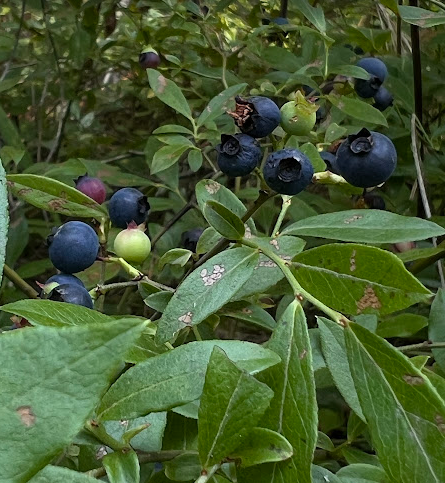
Wild blueberry shrubs only grow about 8 to 24 inches tall. The ones we found barely reached our shins and carpeted the forest floor. Their leaves are small, shiny, oval-shaped, and only about one to one-and-a-half inches long.
Look down.
The wild blueberries we’re after grow on low, colony-forming shrubs that spread across the woodland floor. They reproduce through underground rhizomes, so if you find one little patch, chances are you’ll find plenty more once you start looking around.
One of the easiest ways to identify a blueberry is by looking at the fruit itself. Every blueberry has a distinctive five-point, star-shaped crown opposite the stem. Before eating any berry you think might be a blueberry, look for that star. It’s a characteristic unique to blueberries.
Wild blueberries are also much smaller than the berries you’ll find at the grocery store.
We started slowly driving forest trails, watching for sunny openings among the pines. We hadn’t been looking for more than thirty minutes when Brandon spotted the first patch.
The bushes hadn’t been touched.
They were loaded with fruit and carpeted the edges of the trail.
It’s silly, but there’s something incredibly satisfying about scouting for a new plant and finding it on your very first trip.
I’m still riding that high.
The next day, I rounded up a few girlfriends and their kiddos, and we headed back.
Being out there with people who’d done this for years mattered more than I expected.
I trusted the research. I trusted the leaves, the low bushes, and the habitat. But there’s a different kind of confidence that comes from a seasoned picker glancing at what you’re holding and giving you a nod. It’s one thing to identify a plant correctly. It’s another to have someone beside you who’s been picking that same patch for ten years confirm it.
That’s the piece research alone can’t give you.
I’ll admit it—I didn’t think I even liked blueberries.
The ones I’ve bought from the grocery store are usually sour, bland, or mealy.
Not these.
They were sweet in a way I wasn’t expecting, and not at all mealy. They snapped when you bit into them, releasing a burst of sweetness that tasted nothing like the blueberries I’d grown up eating.
Okay… maybe I finally understand why people guard their blueberry spots.
I was also surprised by how fragrant they were. I had my nose in the jar the entire walk back to the truck.
We spent about two hours picking, and I filled about three-quarters of a quart jar. I probably could have filled the whole thing, but it was hard not to eat them while I picked. I also happily shared quite a few with my three-year-old niece. That’s a trade I’ll make every time if it means she grows up knowing where her food comes from.
Funny enough, I didn’t know about the five-point crown that day in the woods.
I only learned about it later while researching toxic look-alikes for this very post.
Brandon and I identified them based on what our friends had taught us: low bushes, sandy soil, and evergreen forests. It worked, but if I’d stumbled across a berry that looked close enough and didn’t know to check for that star-shaped crown, I might not have caught the difference.
That’s foraging, though.
You learn one layer, go out and use it, then come back and learn the next.
One final word of caution: never eat a wild berry unless you’re completely confident in its identification. Wild blueberries do have toxic look-alikes, so always verify what you’ve found before taking that first bite. The five-point, star-shaped crown opposite the stem is one of the easiest ways to distinguish a blueberry from other berries. When in doubt, leave it in the woods.
I may not have come home with enough blueberries to fill the freezer.
What I brought home was something even better.
Confidence.
A week ago, blueberries were another plant I admired from a distance because I wasn’t sure I could identify them correctly. Now I know what kind of woods they prefer, what the bushes look like, and exactly what to look for before picking that first berry.
That’s the funny thing about learning to forage.
The hardest part usually isn’t identifying the plant.
It’s convincing yourself to go look for it.
Once you do, the woods start feeling a little smaller and a little more familiar. Every new plant you learn gives you the confidence to learn another.
If blueberries still feel a little intimidating, that’s okay.
They’re not where I’d recommend most people start.
Raspberries and blackberries are far more forgiving, have very few dangerous look-alikes, and grow almost everywhere across northern Minnesota. Learning to recognize those first will teach you how to slow down, pay attention to your surroundings, and build confidence before tackling more challenging plants.
Every experienced forager started somewhere.
For me, blueberries were the next step.
Maybe for you, it’s raspberries growing along an old logging road or a patch of blackberries soaking up the sun at the edge of a trail.
Wherever you begin, just begin.
The woods have been there all along. You just have to start seeing them a little differently.